Complete Guide
What Can You Do With an EIN? 8 Essential Uses (2026)
Your EIN unlocks banking, taxes, hiring, business credit, payment processing, licensing, and more. Here are the 8 most important things you can do with your Employer Identification Number.
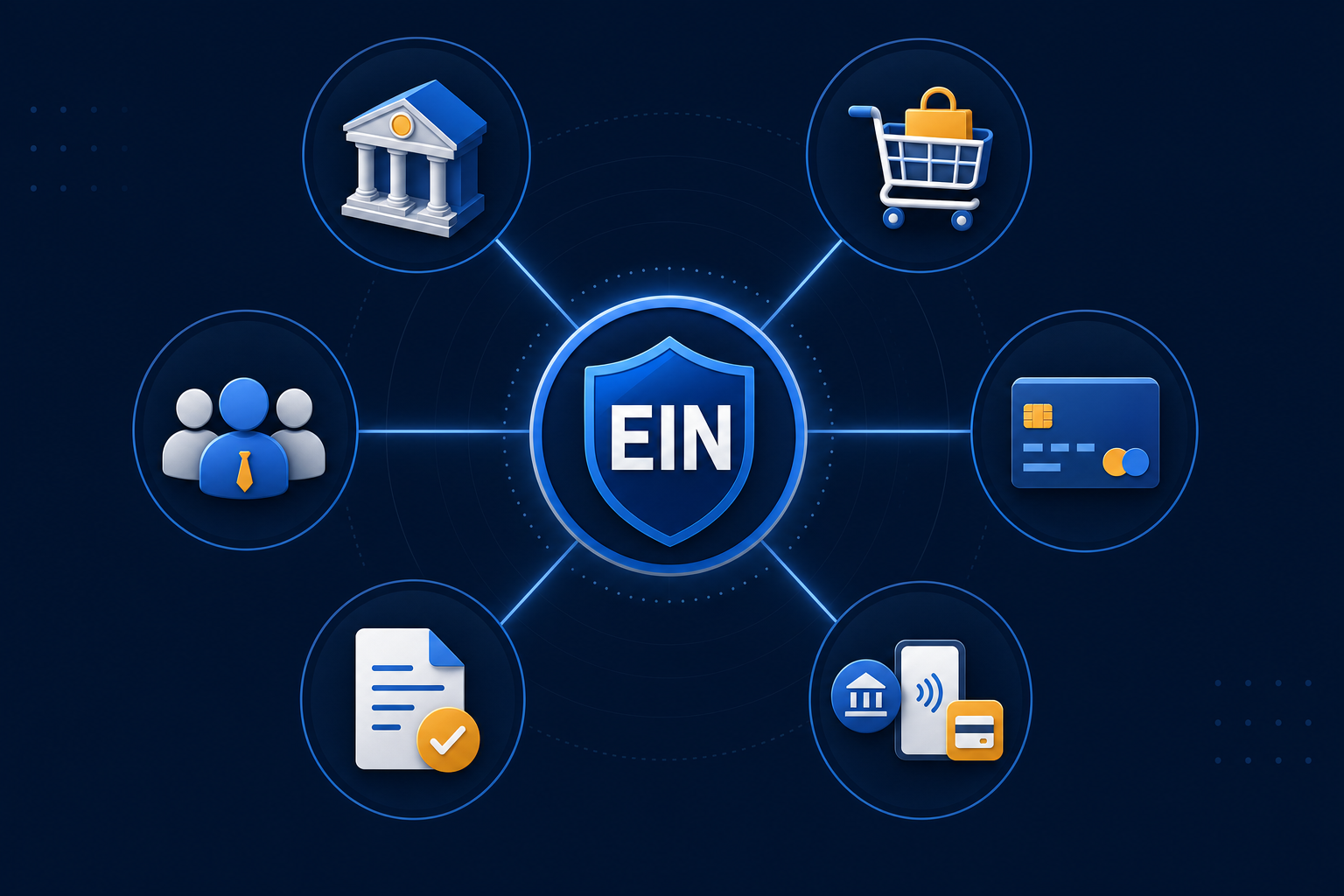
Many entrepreneurs apply for an EIN because they are told they need one, but they do not fully understand how many doors it opens. Your EIN is not just a tax number -- it is the foundation of your business's financial and legal identity in the United States. Every bank, payment processor, government agency, and business partner will ask for it.
This guide covers the eight most important uses of an EIN, with specific details on how each one works and why it matters for your business. Whether you are a US resident launching a startup or a non-resident building an ecommerce business from overseas, these are the core capabilities your EIN provides.
Use #1
How Do You Use an EIN to Open a Business Bank Account?
Opening a business bank account is the most common first use of an EIN. Every US bank requires an EIN before they will open a business checking or savings account. This applies to all entity types: LLCs, corporations, partnerships, and even sole proprietors who want a separate business account. Without an EIN, you cannot separate your business finances from your personal finances.
To open a business bank account, you need your EIN confirmation letter (IRS Letter 147C or CP 575), your business formation documents (Articles of Organization for LLCs, Articles of Incorporation for corporations), a government-issued ID, and your business address. Some banks also require an operating agreement for LLCs or corporate bylaws for corporations.
Banks That Accept Non-Resident EIN Applications
| Bank | Min Deposit | Remote Open? | Key Features |
|---|---|---|---|
| Mercury | $0 | Yes | Free ACH, wires, virtual cards; popular with startups |
| Relay | $0 | Yes | Multiple checking accounts; no minimum balance |
| Brex | $0 | Yes | Corporate cards with no personal guarantee; FDIC insured |
| Chase Business | $0 (or $15/mo fee) | No (in-person) | 16,000 branches; strong for domestic businesses |
| Bank of America | $100 | No (in-person) | 4,000 branches; $16/mo fee waived at $5,000 balance |
| Wise Business | $0 | Yes | Multi-currency accounts; low international transfer fees |
Read our EIN for Bank Account guide for a full list of banks that work with non-residents and detailed requirements for each institution. For international payment platforms, see our guides for PayPal, Stripe, and Payoneer.
Use #2
How Do You Use an EIN to File Federal Taxes?
Your EIN is required on every federal tax return your business files. The specific form depends on your entity type: C-Corporations file Form 1120, S-Corporations file Form 1120-S, partnerships file Form 1065, and sole proprietors use their EIN on Schedule C attached to their personal Form 1040. Without an EIN, the IRS cannot process your business tax return.
Information Returns and 1099 Filing
Your EIN also appears on information returns you file with the IRS. If you pay independent contractors $600 or more during the year, you must file Form 1099-NEC reporting those payments, and your EIN appears as the payer's Tax Identification Number. Employees receive W-2 forms that show your EIN. The IRS uses your EIN to match all of these documents and verify that your tax reporting is accurate and complete.
Non-resident business owners with US-source income must also file annual tax returns with the IRS, even if they do not live in the United States. An EIN is essential for these filings. Common forms for non-residents include Form 1040-NR (for individuals with US income) and Form 5472 (for foreign-owned single-member LLCs).
Use #3
How Do You Use an EIN to Hire Employees?
The word "Employer" in Employer Identification Number exists for a reason: the original and primary purpose of an EIN is to identify employers for payroll tax reporting. If you hire even one employee, you must have an EIN. The IRS requires it for reporting federal income tax withholding, Social Security tax, and Medicare tax (collectively known as FICA taxes).
With your EIN, you file Form 941 (Employer's Quarterly Federal Tax Return) every quarter to report employment taxes. At the end of each year, you issue W-2 forms to every employee showing their wages and the taxes withheld. You also file Form W-3 (Transmittal of Wage and Tax Statements) with the Social Security Administration. All of these forms require your EIN.
Beyond federal requirements, your EIN is also needed to register for state payroll taxes, set up workers' compensation insurance, and register with your state's unemployment insurance program. See our EIN for Hiring Employees guide for a complete checklist of everything you need to do before bringing on your first hire.
Use #4
How Do You Use an EIN to Build Business Credit?
Your EIN is the foundation of your business credit profile. Business credit bureaus -- Dun & Bradstreet, Experian Business, and Equifax Business -- use your EIN to track your business's payment history, credit utilization, and overall financial health. Without an EIN, you cannot establish a business credit profile separate from your personal credit.
Steps to Build Business Credit With Your EIN
Building business credit starts with registering your business with Dun & Bradstreet to get a D-U-N-S number (free), which is linked to your EIN. From there, you open trade accounts with vendors that report to business credit bureaus (such as Uline, Grainger, or Quill), apply for a business credit card, and make consistent on-time payments. Over 12-24 months, your business builds its own credit score (Paydex score of 80+ is the target) independent of your personal credit history.
Strong business credit allows you to qualify for larger loans, better interest rates, and higher credit limits without personally guaranteeing every obligation. This is especially valuable for growing businesses that need capital for inventory, equipment, or expansion. Our EIN for Business Credit guide explains the step-by-step process of building credit with your EIN.
Use #5
How Do You Use an EIN to Accept Payments on Amazon, Stripe, and PayPal?
Every major payment platform that processes transactions in the United States requires a Tax Identification Number for compliance with IRS reporting rules. Amazon Seller Central, Stripe, PayPal, Shopify Payments, and Square all require either an SSN or EIN during account setup. For business accounts and non-resident sellers, an EIN is the correct (and often only) option.
Amazon: Requires a TIN during Seller Central registration. Non-US sellers must provide an EIN. Amazon uses it for 1099-K reporting when your gross sales exceed the IRS threshold. Stripe: Requires a TIN for identity verification and tax reporting. Non-US businesses selling to US customers need an EIN to complete Stripe's account verification. PayPal: Business accounts require a TIN for IRS compliance, and non-residents need an EIN to verify their accounts.
Payment Platforms That Require an EIN
| Platform | EIN Required? | 1099 Threshold | Non-Resident Friendly? |
|---|---|---|---|
| Amazon Seller Central | Yes (for business accounts) | $5,000/year (1099-K) | Yes, with EIN |
| Stripe | Yes (for businesses) | $5,000/year (1099-K) | Yes, with US entity + EIN |
| PayPal Business | Yes (for businesses) | $5,000/year (1099-K) | Yes, with EIN |
| Shopify Payments | Yes (for businesses) | $5,000/year (1099-K) | Yes, with US entity + EIN |
| Square | Yes (for businesses) | $5,000/year (1099-K) | Limited (US address preferred) |
| Etsy | Yes (if US shop) | $5,000/year (1099-K) | Yes, with US tax ID |
Without an EIN, these platforms will restrict your ability to receive payments, issue payouts, or fully verify your account. Our guides for Amazon sellers, Stripe users, and PayPal users provide platform-specific setup instructions.
Use #6
How Do You Use an EIN to Apply for Business Licenses?
Most state and local business license applications require a federal Tax Identification Number, which is your EIN. Whether you are applying for a general business license, a professional license, a sales tax permit, or an industry-specific permit, the licensing authority needs your EIN to verify your business identity and ensure you are registered with the IRS.
State sales tax permits are a common example. If you sell taxable goods or services, most states require you to register for a sales tax permit. The application asks for your EIN (or SSN for sole proprietors). Similarly, state employer tax registrations, professional licenses (for accountants, attorneys, contractors, etc.), and alcohol or food service permits all require a valid EIN.
Federal licenses and permits also use your EIN for identification. If your business is in a regulated industry -- firearms, alcohol, tobacco, transportation, or broadcasting -- you need federal permits that require your EIN. The EIN serves as the universal identifier that connects your business to every level of government regulation and licensing.
Use #7
How Does an EIN Help Establish Your Business Identity?
An EIN separates your business identity from your personal identity. Every time you use your SSN for business purposes -- on W-9 forms, invoices, contracts, or vendor applications -- you expose your personal information to potential identity theft. An EIN eliminates this risk by providing a dedicated number for all business interactions.
EIN as a Credibility Signal
Having an EIN signals that your business is legitimate and properly registered with the IRS. Clients, vendors, and business partners view an EIN as a mark of professionalism. Fortune 500 companies require an EIN before they will add you as a vendor or approve a contract. Government agencies and grant programs verify your EIN during the application process.
For non-resident entrepreneurs, an EIN is especially important because it is often the first US-recognized identifier they obtain. It allows them to start building a legitimate business presence in the United States before they have any physical presence in the country. With an EIN, you can open bank accounts, register with payment processors, and begin conducting business immediately.
Use #8
How Does an EIN Help You Comply with IRS Requirements?
The IRS requires businesses to have an EIN for a wide range of compliance activities. Filing tax returns, reporting employee wages, issuing 1099 forms to contractors, making estimated tax payments, and responding to IRS notices all require your EIN. Without one, you cannot fulfill your federal tax obligations as a business entity.
IRS Forms That Require Your EIN
Specific IRS compliance requirements that need an EIN include: filing Form 941 quarterly for employment taxes (due January 31, April 30, July 31, October 31), filing Form 940 annually for federal unemployment tax (FUTA), issuing W-2 forms to employees by January 31, issuing 1099-NEC forms to contractors by January 31, filing Form 720 for excise taxes, and filing Form 990 for tax-exempt organizations. The EIN appears on every one of these forms.
The $25,000 Penalty for Non-Resident Non-Compliance
Non-resident business owners have additional IRS compliance requirements. Foreign-owned single-member LLCs must file Form 5472 annually by April 15 (or October 15 with an extension), which requires an EIN. Failure to file Form 5472 results in a $25,000 penalty per year. This is one of the most important reasons non-residents need to obtain an EIN promptly after forming a US business entity. Ready to get your EIN? Apply now -- ein.so offers Standard ($49) and Express ($97) packages.
Frequently Asked Questions
Can I use my EIN to open a personal bank account?
No. An EIN is a business tax identification number and can only be used to open business bank accounts. Personal bank accounts require an SSN or ITIN. However, a business bank account opened with an EIN gives you access to business banking features like higher transaction limits and merchant services.
Can I use my EIN to build personal credit?
No. An EIN is used to build business credit, which is separate from personal credit. Business credit is tracked by agencies like Dun & Bradstreet, Experian Business, and Equifax Business. Building strong business credit with your EIN allows you to qualify for business loans and credit lines without relying solely on your personal credit score.
Can I use my EIN to accept payments on Amazon?
Yes. Amazon Seller Central requires a Tax Identification Number during registration. Non-US sellers must provide an EIN. US sellers can use either their SSN or EIN, but using an EIN is recommended to protect personal information. Your EIN is used for tax reporting on 1099-K forms.
Do I need an EIN to use Stripe or PayPal for business?
Yes. Both Stripe and PayPal require a Tax Identification Number for business accounts to comply with IRS reporting requirements. Non-US residents who sell to US customers or receive US-source income need an EIN to set up verified business accounts on these platforms.
Can I use one EIN for multiple businesses?
Only if those businesses operate under the same legal entity. Each separate legal entity (each LLC, corporation, etc.) needs its own EIN. If you run multiple businesses as DBAs under one sole proprietorship, you use a single EIN. But if each business is a separate LLC, each needs its own EIN.
Can I use my EIN to apply for a business loan?
Yes. An EIN is required for most business loan applications. Lenders use your EIN to verify your business identity, check your business credit history, and process the loan. Banks, SBA lenders, and online lending platforms all require an EIN as part of the application process.
What happens if I do not use my EIN after getting it?
The IRS may deactivate your EIN if it is not used on any federal tax return or filing for three or more consecutive years. The EIN itself does not expire, but it can become inactive. If this happens, you may need to contact the IRS to reactivate it or apply for a new one.
Can I use my EIN for tax-exempt purchases?
An EIN alone does not grant tax-exempt status. Tax-exempt purchases require a separate tax exemption certificate from your state, which is tied to your EIN. Nonprofits with 501(c)(3) status can use their EIN along with their determination letter to make tax-exempt purchases.